9 Best Air Quality Monitors for Home (October 2026)
The best home air quality monitors include the Airthings View Plus for broad pollutant coverage, the Awair Element for app-based trend tracking, and the Airthings Wave Plus for battery-powered radon tracking.
On this page (6 sections)
The Airthings View Plus is the best air quality monitor for most homes because it combines radon, PM2.5, CO2, VOC, humidity, temperature, and air pressure readings. For a narrower goal, the Amazon Smart Air Quality Monitor suits Alexa routines, while the GoveeLife H5140 focuses on CO2, temperature, and humidity.
A home air monitor is most useful when its readings match the question you have. Decide whether you need particle tracking, radon monitoring, CO2 trends, chemical readings, or a simple display before choosing extra app features.
If you want a plain explanation of common sensors, start with our guide to home air quality monitor readings. You can also learn what PM2.5 means on an air quality monitor or how to read the numbers on an air quality monitor.
Our picks at a glance
-
1

-
2

-
3

- 4
 Check it
Amazon Smart Air Quality Monitor
Best for Alexa routines - 5
 Best for Ring and Sidewalk usersCheck it
- 6
 Best for detailed particle and gas readingsCheck it
- 7
 Best for an at-a-glance CO2 displayCheck it
- 8
 Check it
AprilAire Smart Air Quality Monitor
Best for AprilAire system integration - 9
 Check it
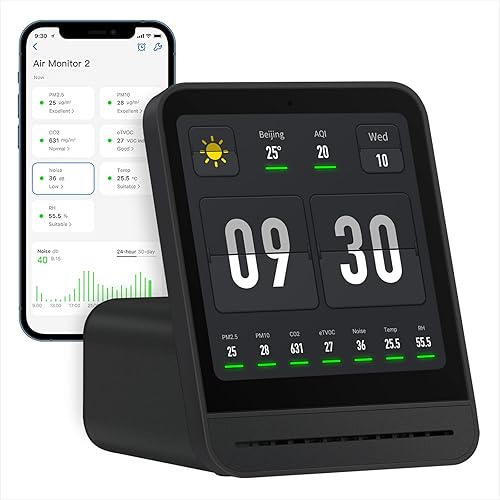
Qingping Air Quality Monitor Gen 2
Best for a large touchscreen display
How we chose the best air quality monitor for home use
The best home air quality monitor is the one that measures the pollutants and conditions you care about, with a display or app you can use. We compared the sensor lists, connection needs, power details, and alerts provided for these models.
A broader sensor list can be helpful, but it does not make every reading equally important to every household. Radon, PM2.5, CO2, VOCs, temperature, and humidity each answer different questions, so weigh the readings you expect to check.
We also looked at practical limits. Some monitors require a specific app or Wi-Fi band, some rely on a particular smart-home system, and portable battery operation varies from a few hours to multiple years.
Our score weighs specs, features, and buyer feedback against what you're shopping for.
| Product | Best for | Readings | Power | Connection | Our score |
|---|---|---|---|---|---|
| Airthings View Plus | broad pollutant coverage | Radon, PM2.5, CO2, VOCs, humidity, temperature, air pressure | Battery powered | Wi-Fi and Airthings app | 9.0 |
| Awair Element | app-based trend tracking | Temperature, humidity, CO2, VOCs, PM2.5 | Not specified | Bluetooth setup and 2.4 GHz Wi-Fi | 8.7 |
| Airthings Wave Plus | battery-powered radon tracking | Radon, CO2, VOCs, humidity, temperature, air pressure | Battery powered | Bluetooth and Airthings app | 8.5 |
| Amazon Smart Air Quality Monitor | Alexa routines | PM2.5, VOCs, carbon monoxide, humidity, temperature | Not specified | Alexa app | 8.4 |
| Ring Air Quality Monitor | Ring and Sidewalk users | Temperature, carbon monoxide, humidity, PM2.5 | Not specified | Amazon Sidewalk required | 7.6 |
| BREATHE Airmonitor Plus Gen 2 | detailed particle and gas readings | CO2, PM1, PM2.5, PM10, TVOC, HCHO, temperature, humidity | USB-C power or up to 6 hours on battery | 2.4 GHz Wi-Fi and Breathe Tech app | 7.9 |
| GoveeLife H5140 CO2 Monitor | an at-a-glance CO2 display | CO2, temperature, humidity | AC powered | App, Alexa, and Google Assistant features | 8.0 |
| AprilAire Smart Air Quality Monitor | AprilAire system integration | CO2, VOCs, PM2.5, humidity, temperature | Corded electric | Wi-Fi and Healthy Air app | 7.4 |
| Qingping Air Quality Monitor Gen 2 | a large touchscreen display | CO2, PM2.5, PM10, eTVOC, noise, temperature, humidity | USB power; up to 3 hours after a full charge | 2.4 GHz or 5 GHz Wi-Fi and Qingping+ app | 7.2 |
Which home air quality monitor fits each need?
The Airthings View Plus offers the broadest coverage in this group, while other models suit a specific reading, display, or smart-home setup. Compare the feature that matters most before narrowing your choice.
Airthings View Plus: Best for broad pollutant coverage
- Radon, PM2.5, CO2, VOCs, humidity, temperature, and air pressure
- Wi-Fi connected with app access
- Battery powered with customizable eInk screen
Broad coverage makes it a fit if you want radon and common air quality readings in one monitor. The app and internet access are required.
Pros
- Includes radon and PM2.5 readings
- Battery powered
- Customizable eInk screen
Cons
- Requires an account, app, and internet access
- Does not replace dedicated safety alarms
The Airthings View Plus is the most complete choice here if you want radon and common indoor air readings in one device. It tracks radon, PM2.5, CO2, VOCs, humidity, temperature, and air pressure.
It is battery powered and has a customizable eInk screen, so you can place it without keeping a power cable attached. The Airthings app is required, and both the monitor and app need internet access.
Airthings says its passive diffusion chamber uses alpha spectrometry for radon detection. The model can help you follow readings over time, including changes after a radon mitigation system is in place.
Choose it if you want broad coverage and app-based monitoring. If radon is your only concern, compare it with our guide to air quality monitors that also measure radon.
Awair Element: Best for app-based trend tracking
- Temperature, humidity, CO2, VOCs, and PM2.5
- Real-time insight and trends in Awair Home app
- Requires Bluetooth setup and 2.4 GHz Wi-Fi
Awair Element covers five common indoor readings and pairs them with app feedback and trends. It does not include radon or carbon monoxide readings.
Pros
- Tracks PM2.5 and CO2 together
- App includes feedback and tips
Cons
- Requires 2.4 GHz Wi-Fi
- Power details are not specified
Awair Element tracks temperature, humidity, CO2, VOCs, and PM2.5 and presents real-time insight and trends in the Awair Home app. Its focus is a compact set of common indoor readings rather than radon or carbon monoxide.
Bluetooth is required for setup, and the monitor needs a 2.4 GHz Wi-Fi connection. The app also includes feedback and tips, which can help you connect a reading change with something happening in the room.
Pick Awair when you want a five-reading monitor and a trend-focused app. If you're comparing models that put more emphasis on phone control, see our roundup of smart air quality monitors with an app.
Airthings Wave Plus: Best for battery-powered radon tracking
- Radon, CO2, VOCs, humidity, temperature, and air pressure
- Battery powered
- Color indication by waving at the device
Wave Plus combines radon monitoring with several room readings in a battery-powered unit. You can view a color indication on the device or use the app.
Pros
- Includes radon and CO2
- Battery powered
- Color indication on device
Cons
- Does not measure PM2.5
- Bluetooth is used for app connection
Airthings Wave Plus is a battery-powered option for buyers who want radon monitoring alongside CO2 and other room readings. Its six sensors cover radon, CO2, VOCs, humidity, temperature, and air pressure.
To check the device itself, wave a hand in front of it for a color-coded indication. You can also connect by Bluetooth to the Airthings app for more detailed information.
Wave Plus does not include a PM2.5 sensor, so choose View Plus if fine-particle tracking is part of your plan. This model makes more sense when radon, battery placement, and a quick visual indicator matter more.
Amazon Smart Air Quality Monitor: Best for Alexa routines
- PM2.5, VOCs, carbon monoxide, humidity, and temperature
- Color-coded LED and Alexa app score
- Phone alerts and compatible Alexa routines
This monitor fits an Alexa household that wants alerts and routines tied to readings. It measures carbon monoxide, but it is not a substitute for a certified CO alarm.
Pros
- Includes carbon monoxide and PM2.5 readings
- Can trigger compatible Alexa routines
- Color-coded LED
Cons
- Does not measure radon or CO2
- CO reading is not a certified alarm
The Amazon Smart Air Quality Monitor fits a home that already uses Alexa and wants alerts or routines based on indoor readings. It tracks PM2.5, VOCs, carbon monoxide, humidity, and temperature, with a color-coded LED and an air quality score in the Alexa app.
You can set phone notifications or announcements on Echo devices when Alexa detects poor indoor air quality. Compatible routines can also control devices such as fans, dehumidifiers, or air purifiers.
The CO reading is not a substitute for a certified carbon monoxide alarm, and this monitor does not measure CO2 or radon. Choose it for Alexa features and its specific readings, not as a full pollutant panel.
Ring Air Quality Monitor: Best for Ring and Sidewalk users
- Temperature, carbon monoxide, humidity, and PM2.5
- Connects over Amazon Sidewalk
- Smart suggestions and actionable alerts
Ring's monitor focuses on a short set of room readings and connects through Amazon Sidewalk. It has no microphone or speaker, and its CO reading does not replace a CO alarm.
Pros
- Tracks PM2.5 and carbon monoxide
- No base station required
Cons
- Requires Amazon Sidewalk coverage
- Does not measure CO2 or radon
Ring Air Quality Monitor tracks temperature, carbon monoxide, humidity, and PM2.5 and connects through Amazon Sidewalk. It needs no base station, though Sidewalk is required and coverage can vary.
Ring offers prompts when you may want to open a window, run a purifier, or service an appliance. The device has no microphone or speaker, so it cannot sound an alarm.
Like the Amazon monitor, Ring's CO reading does not replace a certified carbon monoxide alarm. It also does not measure CO2 or radon, so look elsewhere if those readings matter to you.
BREATHE Airmonitor Plus Gen 2: Best for detailed particle and gas readings
- CO2, PM1, PM2.5, PM10, TVOC, formaldehyde, temperature, and humidity
- 90-day app history and data export
- Up to 6 hours of portable battery use
This model tracks several particle sizes plus CO2, TVOC, and formaldehyde. Its app supports alerts, history, and data export, while portable use is limited to up to 6 hours.
Pros
- Tracks PM1, PM2.5, and PM10
- Includes formaldehyde reading
- Supports data export
Cons
- Portable battery use is limited
- Requires 2.4 GHz Wi-Fi for app connection
BREATHE Airmonitor Plus Gen 2 is a good fit when you want several particle sizes and gas readings in one display. It measures CO2, PM1, PM2.5, PM10, TVOC, formaldehyde, temperature, and humidity.
The Breathe Tech app supports configurable CO2 and PM2.5 alerts, up to 90 days of stored history, and data export. The monitor can run on battery for up to 6 hours or stay connected to USB-C power.
This model offers more detail than a simple CO2 monitor, but it needs 2.4 GHz Wi-Fi for app use. Pick it if particle sizes, formaldehyde, and exported trends matter more than long portable use.
GoveeLife H5140 CO2 Monitor: Best for an at-a-glance CO2 display
- CO2, temperature, and humidity readings
- Display with clock and tri-color light bar
- App alerts and historical data export
The H5140 centers on CO2 and shows temperature and humidity on its display. It is a focused choice for rooms where you want CO2 readings and alerts without a broader pollutant panel.
Pros
- Clear CO2 display
- Customizable alerts
- App supports historical data export
Cons
- Does not measure particles, radon, or VOCs
- Requires AC power
The GoveeLife H5140 is a focused choice for a bedroom, office, or other room where you want CO2, temperature, and humidity at a glance. Its display also shows a clock when connected to the app.
The monitor runs on AC power and offers a tri-color light bar, customizable thresholds, and app notifications. The app can track up to two years of historical data and export CSV reports.
GoveeLife says the H5140 uses an SCD4x CO2 sensor based on the photoacoustic NDIR principle. It does not measure particles, radon, or VOCs, so choose a broader monitor if those readings are part of your goal.
AprilAire Smart Air Quality Monitor: Best for AprilAire system integration
- CO2, VOCs, PM2.5, humidity, and temperature
- Healthy Air app with alerts and trend data
- Can integrate with select AprilAire thermostats and equipment
This monitor covers five common readings and can connect with select AprilAire equipment for system actions. The app is required, and some integration needs a compatible AprilAire thermostat.
Pros
- Tracks PM2.5 and CO2
- App includes trends and notifications
- Three light options
Cons
- Requires the Healthy Air app
- Some system features require a separate compatible thermostat
The AprilAire Smart Air Quality Monitor suits buyers who want CO2, VOC, PM2.5, humidity, and temperature readings with app alerts and trend information. It needs the AprilAire Healthy Air app to function.
Its status colors give a quick visual cue, while the app presents values, trends, notifications, and tips. The monitor can integrate with select AprilAire ventilation or filtration equipment, but that setup requires a compatible AprilAire Wi-Fi thermostat sold separately.
Choose it if you already use AprilAire equipment or want its app guidance. For a stand-alone monitor without system integration as a deciding factor, compare the sensor and power needs of the other picks.
Qingping Air Quality Monitor Gen 2: Best for a large touchscreen display
- CO2, PM2.5, PM10, eTVOC, noise, temperature, and humidity
- 4-inch touchscreen with clock and alarms
- Wi-Fi app access and historical data export
Qingping pairs a broad set of readings with a touchscreen, alarm clock, and app history. It does not measure formaldehyde and is intended to stay connected to USB power for daily use.
Pros
- Large touchscreen
- Includes noise and PM10 readings
- Supports app history export
Cons
- Does not measure formaldehyde or radon
- Battery operation lasts up to 3 hours
Qingping Air Quality Monitor Gen 2 combines a large touchscreen with CO2, PM2.5, PM10, eTVOC, noise, temperature, and humidity readings. Its screen also supports the date, time, and multiple alarms.
You can connect it to Qingping+ over 2.4 GHz or 5 GHz Wi-Fi to view readings remotely and export historical data. The PM sensor is replaceable, and the screen brightness can adjust automatically.
Qingping says the monitor should stay connected to USB power in daily use, though its built-in battery can run for up to 3 hours. It does not measure formaldehyde or radon, so keep that limitation in mind if either is a priority.
How should you choose a home air quality monitor?
Choose a home air quality monitor by the reading you need to act on, then check how you'll view the data and power the device. A long feature list matters only when it covers your actual concern.
For fine particles from cooking, smoke, or outdoor pollution, look for a PM2.5 reading. Our guide to the difference between PM2.5 and PM10 explains what the two particle labels represent.
If your main question is ventilation, a CO2-focused monitor may be enough. CO2 does not tell you about radon, particles, or most VOCs, so don't treat one number as an overall air quality score.
For chemical readings, compare what each model measures. VOC or TVOC readings, and a separate formaldehyde reading, are not interchangeable; see VOC vs TVOC on a monitor for the distinction.
Do you need radon, carbon monoxide, or both?
Radon and carbon monoxide are different concerns, and a home air monitor that measures one may not measure the other. Check the sensor list and keep dedicated safety devices where required.
View Plus and Wave Plus include radon readings, while the Amazon and Ring monitors include carbon monoxide readings. The Amazon and Ring product information specifically says their CO readings are not certified CO alarms or detectors.
If radon is your priority, compare these picks with the best radon monitors for home. For carbon monoxide safety, use a proper CO alarm rather than relying on an air quality monitor.
Are smart air quality monitors worth choosing?
A smart air quality monitor is useful when you want alerts, remote readings, or trends in an app. Check whether the model needs a specific Wi-Fi band, account, smart-home platform, or internet connection.
View Plus requires the Airthings app, an account, and internet access. Awair Element requires Bluetooth for setup and 2.4 GHz Wi-Fi, while Ring requires Amazon Sidewalk.
For a screen-first setup, Qingping provides readings on a touchscreen, and the GoveeLife H5140 shows CO2, temperature, and humidity on its display. Consider where you'll put the monitor and whether a cable, app, or smart-home link fits that room.
Which best air quality monitor for home should you choose?
Choose the Airthings View Plus if you want one monitor for radon, PM2.5, CO2, VOCs, humidity, temperature, and air pressure. Choose Awair Element for app-based trends, Amazon Smart Air Quality Monitor for Alexa routines, or GoveeLife H5140 for a focused CO2 display.
If you need more particle detail, consider BREATHE Airmonitor Plus Gen 2 or Qingping Air Quality Monitor Gen 2. For radon-specific choices, see our home radon monitor guide, then match the sensor set to the question you need answered.
Our top 3 picks at a glance
-
1
-
2
-
3
Frequently asked questions
What should a home air quality monitor measure?
Choose readings based on the question you want answered. PM2.5 helps track fine particles, CO2 can show changes tied to occupancy and ventilation, and VOC readings can show changes in some airborne chemicals.
Radon is a separate concern, so choose a monitor that specifically includes radon if you want continuous radon readings.
Do air quality monitors measure carbon monoxide?
Some do, including the Amazon Smart Air Quality Monitor and Ring Air Quality Monitor. Their CO readings do not make them substitutes for a certified carbon monoxide alarm.
Keep a proper CO alarm for safety, and use an air monitor for the readings and features it was designed to provide.
Can one monitor measure radon and PM2.5?
Yes. Airthings View Plus measures both radon and PM2.5, along with CO2, VOCs, humidity, temperature, and air pressure.
Check the exact sensor list before choosing a monitor because models with similar names can measure different things.
Does a CO2 monitor measure overall air quality?
A CO2 reading covers carbon dioxide, which can help you notice changes in a room as people use it and ventilation changes. It does not measure particles, radon, or most other pollutants by itself.
For broader coverage, choose a monitor with the other readings you need.
Are home air quality monitors accurate?
Accuracy depends on the sensor, setup, room conditions, and what the monitor measures. A device that estimates one reading cannot answer every air quality question.
See our guide to how accurate home air quality monitors are and compare each model's sensor claims with your needs.


