9 Best PM2.5 Monitors for Indoor Air (October 2026)
The best indoor PM2.5 monitors include the Airthings View Plus for connected whole-room tracking, the Awair Element for app-based air trends, and the Amazon Smart Air Quality Monitor for Alexa routines.
On this page (7 sections)
The Airthings View Plus is the best PM2.5 monitor for most homes if you want particle readings alongside radon, CO2, VOCs, humidity, temperature and air pressure. For a focused PM2.5 and PM10 display, the Temtop P600 keeps the job simple, while BREATHE adds app history and data export.
A PM2.5 reading can help you spot changes around cooking, cleaning, smoke or ventilation. For a plain-language explanation of what the number means, start with what PM2.5 means on an air quality monitor.
Our picks at a glance
-
1

-
2

-
3

- 4
 Best for exported particle historyCheck it
- 5
 Best for basic Ring-connected checksCheck it
- 6
 Check it
Temtop LKC-1000S+ Air Quality Monitor
Best for portable trend checks and export - 7
 Check it
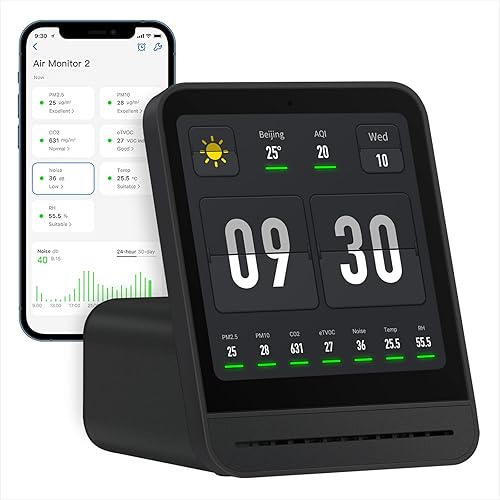
Qingping Air Quality Monitor Gen 2
Best for a large touchscreen display - 8
 Check it
AirKnight Premium Air Quality Monitor
Best for cordless room-to-room checks - 9
 Best for focused particle readingsCheck it
How we chose these PM2.5 monitors
We compared the measures each model tracks, how it displays or stores readings, and whether it needs an app or a power connection. Our score weighs specs, features and buyer feedback against what you’re shopping for.
A dedicated particle counter can be a good fit if PM2.5 is your main concern. A multi-sensor monitor can add context, such as humidity or CO2, but more readings don't automatically make it the right choice for every room.
Compare the best PM2.5 monitors
The best PM2.5 monitor for your home depends on whether you want connected history, a broad set of indoor readings or a portable particle check. Compare the key differences before choosing.
| Product | Best for | Measures | Power | Connectivity | Our score |
|---|---|---|---|---|---|
| Airthings View Plus | connected whole-room tracking | Radon, PM2.5, CO2, VOCs, humidity, temperature and air pressure | Battery powered; 6 AA batteries and USB-C cable included | Wi-Fi; Airthings app and internet required | 9.0 |
| Awair Element | app-based air trends | PM2.5, CO2, VOCs, temperature and humidity | Bluetooth setup and 2.4 GHz Wi-Fi | 8.7 | |
| Amazon Smart Air Quality Monitor | Alexa routines | PM2.5, VOCs, carbon monoxide, humidity and temperature | 8.4 | ||
| BREATHE Airmonitor Plus Gen 2 | exported particle history | PM1, PM2.5, PM10, CO2, TVOC, formaldehyde, temperature and humidity | Up to 6 hours portable; can run on USB-C power | 7.9 | |
| Ring Air Quality Monitor | basic Ring-connected checks | PM2.5, carbon monoxide, temperature and humidity | Amazon Sidewalk required; coverage may vary | 7.6 | |
| Temtop LKC-1000S+ Air Quality Monitor | portable trend checks and export | PM2.5, PM10, HCHO, VOCs, humidity, temperature and AQI | 6–8 hours portable; USB-C for continuous monitoring | 7.3 | |
| Qingping Air Quality Monitor Gen 2 | a large touchscreen display | PM2.5, PM10, CO2, eTVOC, noise, temperature and humidity | USB power recommended; up to 3 hours on battery | 7.2 | |
| AirKnight Premium Air Quality Monitor | cordless room-to-room checks | PM2.5, PM10, CO2, TVOC, HCHO, temperature and humidity | Rechargeable 3000 mAh battery | 6.8 | |
| Temtop P600 PM2.5 Monitor | focused particle readings | PM2.5 and PM10 | 6.7 |
Which PM2.5 monitor fits your home?
The Airthings View Plus is the most complete connected pick here, while the Temtop P600 is the most focused option. Use the product notes below to match features to the way you plan to check indoor air.
Airthings View Plus: Best for connected whole-room tracking
- Tracks PM2.5, radon, CO2, VOCs, humidity, temperature and air pressure
- Wi-Fi and app required
- Battery powered with customizable eInk screen
A broad choice for keeping PM2.5 in context with several other indoor readings. Its app and internet needs make it better for connected tracking than for offline-only use.
Pros
- Tracks radon and several air quality measures
- Customizable eInk screen
- Airthings offers an optional free extended warranty with registration
Cons
- Requires an account, app and internet access
- More measurements than a particle-only buyer may need
Airthings View Plus makes sense if you want PM2.5 as one part of a wider picture of your home’s air. It also measures radon, CO2, VOCs, humidity, temperature and air pressure, so you can follow several types of readings from one device.
The monitor is battery powered and has a customizable eInk screen. Airthings says the app is required, and the monitor and app both need internet access, so it suits a connected setup.
Its wider range of measures may be more than you need if you only want to check particle changes. For a closer look at multi-sensor options, see our guide to the best air quality monitors for home.
Awair Element: Best for app-based air trends
- Tracks PM2.5, CO2, VOCs, temperature and humidity
- Awair Home app provides real-time insight and trends
- Bluetooth setup and 2.4 GHz Wi-Fi required
Element pairs particulate readings with common room measures and app feedback. It fits shoppers who want more than a standalone particle count.
Pros
- Includes PM2.5 and four other measures
- App shows changes over time
- In-app feedback and tips
Cons
- Requires Bluetooth for setup and 2.4 GHz Wi-Fi
- Does not measure radon
Awair Element tracks PM2.5 with CO2, VOCs, temperature and humidity, then shows real-time insights and changes over time in the Awair Home app. This makes it a useful fit if you want a connected view of both particles and everyday room conditions.
Setup requires Bluetooth, and the device needs a 2.4 GHz Wi-Fi connection. If you want to learn how common air monitor readings are presented, our guide to reading the numbers on an air quality monitor can help.
Choose it for app-based trends and feedback. If you want radon readings as well, Airthings View Plus covers that measure.
Amazon Smart Air Quality Monitor: Best for Alexa routines
- Tracks PM2.5, VOCs, carbon monoxide, humidity and temperature
- Color-coded LED and Alexa app air quality score
- Phone notifications and Echo announcements
This is a practical fit if you already use Alexa and want alerts or routines linked to indoor readings. It also tracks carbon monoxide, but it is not a substitute for a certified CO alarm.
Pros
- Can trigger compatible Alexa routines
- LED gives a quick color-coded indication
- Tracks temperature and humidity too
Cons
- Designed around the Alexa app and compatible devices
- Carbon monoxide sensing does not replace a CO alarm
Amazon Smart Air Quality Monitor makes the most sense in an Alexa-centered home. Its color-coded LED gives a quick indication, while the Alexa app provides an air quality score and more detail.
It tracks PM2.5, VOCs, carbon monoxide, humidity and temperature. Alexa can send phone notifications or make announcements on Echo devices, and compatible devices can be tied to routines.
The carbon monoxide reading is not a substitute for a certified CO alarm. Choose this monitor for Alexa alerts and routines, not as your home’s only carbon monoxide safety device.
BREATHE Airmonitor Plus Gen 2: Best for exported particle history
- Tracks PM1, PM2.5, PM10, CO2, TVOC, formaldehyde, temperature and humidity
- App history up to 90 days with data export
- Up to 6 hours of portable use
BREATHE combines particle sizes with gas readings and gives you app graphs, alerts and exportable history. Its short battery life favors room-to-room checks or use near power.
Pros
- Measures PM1, PM2.5 and PM10
- App supports alerts and up to 90 days of history
- Data export available
Cons
- Portable use is up to 6 hours
- 2.4 GHz Wi-Fi is needed for app connection
BREATHE Airmonitor Plus Gen 2 suits buyers who want PM2.5 readings with saved trends they can review later. It tracks PM1, PM2.5 and PM10 along with CO2, TVOC, formaldehyde, temperature and humidity.
The app supports configurable CO2 and PM2.5 alerts, graphs, up to 90 days of stored data and export. Its battery supports up to 6 hours of portable use, and it can also run while connected to USB-C power.
Choose it if app history and export matter to you. If you mainly want a handheld particle check, the Temtop P600 has a simpler set of measures.
Ring Air Quality Monitor: Best for basic Ring-connected checks
- Tracks PM2.5, carbon monoxide, temperature and humidity
- Connects over Amazon Sidewalk
- Provides prompts when conditions may call for action
Ring covers PM2.5 and a small set of room conditions for homes that can use Amazon Sidewalk. It does not measure CO2 or radon and has no speaker to sound an alarm.
Pros
- No base station required
- Tracks PM2.5 alongside temperature and humidity
- Provides suggestions based on readings
Cons
- Amazon Sidewalk is required and coverage may vary
- Not a CO alarm or detector
Ring Air Quality Monitor tracks PM2.5, carbon monoxide, temperature and humidity, and can provide prompts when conditions may call for action. It connects over Amazon Sidewalk, which is required for use and may have varying coverage.
Ring states that the monitor is not a substitute for a carbon monoxide alarm. It also does not measure CO2 or radon, so choose it for basic room readings when Sidewalk works in your home.
Temtop LKC-1000S+ Air Quality Monitor: Best for portable trend checks and export
- Tracks PM2.5, PM10, HCHO, VOCs, humidity, temperature and AQI
- 12-hour trend histogram
- USB data export; 6–8 hours of portable battery use
The LKC-1000S+ suits buyers who want to move a monitor between rooms and review particle changes alongside other measures. It also exports data over USB without an app.
Pros
- Tracks PM2.5 and PM10
- USB export for data review
- Portable battery supports spot checks
Cons
- For continuous monitoring, it needs to stay connected to USB power
- The maker describes it as a trend indicator, not a lab-grade instrument
Temtop LKC-1000S+ combines PM2.5 and PM10 with HCHO, VOCs, humidity, temperature and AQI. A 12-hour trend histogram helps you see short-term changes, and USB data export lets you review readings without an app.
It supports 6–8 hours of portable spot checks, then needs its Type-C cable for continuous monitoring. Temtop describes it as a trend indicator rather than a lab-grade instrument, so use it to notice patterns rather than treat a single reading as a precise measurement.
Qingping Air Quality Monitor Gen 2: Best for a large touchscreen display
- Tracks PM2.5, PM10, CO2, eTVOC, noise, temperature and humidity
- 4-inch touchscreen with 24-hour and 30-day history
- Wi-Fi app can show readings remotely
Qingping makes room readings easy to see on its built-in screen, with PM2.5 shown alongside several other metrics. Its battery is intended for short use, so plan on USB power for daily monitoring.
Pros
- Large touchscreen with adjustable brightness
- Replaceable PM sensor
- App can show readings remotely and export history
Cons
- Does not measure formaldehyde
- Battery lasts up to 3 hours
Qingping Air Quality Monitor Gen 2 puts PM2.5 and PM10 on a 4-inch touchscreen alongside CO2, eTVOC, noise, temperature and humidity. It also shows time and date, and includes an alarm clock function.
Its app can show readings remotely over Wi-Fi and supports historical data and export. The monitor can run for up to 3 hours on battery, but Qingping recommends keeping it connected to USB power for daily use.
The replaceable PM sensor is a useful maintenance feature. Note that this model does not measure formaldehyde.
AirKnight Premium Air Quality Monitor: Best for cordless room-to-room checks
- Tracks PM2.5, PM10, CO2, TVOC, HCHO, temperature and humidity
- Rechargeable 3000 mAh battery
- Large LCD screen; no Wi-Fi or app required
AirKnight is a portable pick for checking multiple readings around the home without connecting to an app. Choose it when a screen and cordless movement matter more than saved trends.
Pros
- Tracks PM2.5 and PM10 alongside other measures
- No Wi-Fi or app required
- Portable rechargeable design
Cons
- No app-based history is described
- More readings than a particle-only user may need
AirKnight Premium Air Quality Monitor is a portable choice if you want to check multiple readings without an app. It tracks PM2.5 and PM10 alongside CO2, TVOC, HCHO, temperature and humidity on an LCD screen.
Its rechargeable 3000 mAh battery supports moving the unit between rooms. With no Wi-Fi or app required, it favors direct readings over remote alerts or saved app history.
Choose it when portability and a standalone display matter. For a monitor with recorded particle trends, consider the Temtop LKC-1000S+ or BREATHE.
Temtop P600 PM2.5 Monitor: Best for focused particle readings
- Measures PM2.5 and PM10
- Displays a 12-hour histogram
- Handheld design with back stand
The P600 focuses on particle readings and a short-term trend display, making it a straightforward option for PM2.5 checks. It does not add app connectivity or gas measurements.
Pros
- Focused PM2.5 and PM10 readings
- 12-hour histogram
- Handheld design for indoor or outdoor checks
Cons
- Does not track gases or other room measures
- No app connectivity is described
Temtop P600 is the most focused PM2.5 monitor in this group. It measures PM2.5 and PM10, displays colorful health-level indicators and stores data for a 12-hour histogram.
Its handheld design and back stand let you use it as a portable check or leave it on a surface. The limited set of measures is a plus if you want particle readings without app setup or extra gas sensors.
Choose the P600 for straightforward PM2.5 and PM10 tracking. Pick a broader monitor if you also want readings such as CO2 or VOCs.
What should a PM2.5 monitor measure?
A PM2.5 monitor should report fine particle levels clearly and consistently, with extra features based on your needs. Some models here add PM10, which measures a larger particle size range.
If you want more context, consider whether CO2, VOCs, humidity or temperature readings would help you understand changes in a room. Our guide to PM2.5 and PM10 explains how the two particle readings differ.
Do you need an app or a screen?
Choose a screen-first monitor if you want to glance at readings in the room, and choose an app-connected model if you want remote checks or saved trends. Some devices offer both, while others focus on direct display and portable use.
App features vary, so check whether a model stores history, sends alerts or exports data. If understanding the readings themselves is the next step, see our guide on how to read an air quality monitor.
How should you use PM2.5 readings?
Use readings to notice patterns, then compare them with what is happening in the room. Cooking, smoke, cleaning activity and ventilation can coincide with changes, but one number by itself doesn't identify a source.
Keep the monitor in a consistent spot when tracking changes over time. Avoid blocking its air openings and follow the setup guidance for the model you choose.
Which PM2.5 monitor should you choose?
Pick the Airthings View Plus if you want connected PM2.5 tracking with radon and other room readings. Choose the Temtop P600 for focused particle checks, or BREATHE if you want app history and data export; for a wider home-monitor comparison, see our best air quality monitors for home.
Our top 3 picks at a glance
-
1
-
2
-
3
Frequently asked questions
What should you look for in a PM2.5 monitor?
Choose a monitor that clearly reports PM2.5 and suits how you plan to use it. A focused unit such as the Temtop P600 tracks PM2.5 and PM10, while broader monitors add readings such as CO2, VOCs or humidity.
For ongoing tracking, check whether the model offers app history or a trend display.
Is a PM2.5 monitor the same as an air quality monitor?
A PM2.5 monitor measures fine particles, while an air quality monitor may track particles plus other readings such as CO2, VOCs, temperature or humidity. Check the measures for each model, since the broad label alone doesn't tell you what it senses.
For a plain explanation of other readings, see our home air quality monitor guide.
Can a PM2.5 monitor detect carbon monoxide?
A PM2.5 monitor detects particles, not necessarily carbon monoxide. Some broader units, including the Amazon Smart Air Quality Monitor and Ring Air Quality Monitor, also register CO, but neither should replace a certified carbon monoxide alarm.
Use the right device for each safety need.
Where should you place an indoor PM2.5 monitor?
Place it in the room you want to understand, with its air openings clear and away from direct drafts or a spot where it could be blocked. Follow the model’s setup guidance and keep placement consistent when comparing readings over time.
If you move a monitor between rooms, note the location and time.
How do you choose between PM2.5 and PM10 readings?
PM2.5 and PM10 refer to different particle size ranges, so a monitor that reports both can help you compare changes in finer and larger particles. For a simple explanation of what those readings count, read our PM2.5 vs PM10 guide.
Pick a model with the measures that match the question you want to answer.


