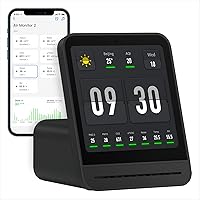
How Does a PM2.5 Monitor Work?
A PM2.5 monitor pulls room air into its sensor with a small fan, shines a laser across that air, and counts how much light bounces off the floating particles. Firmware weighs the particles by size to estimate PM2.5 in micrograms per cubic meter and converts that into the PM2.5 reading and AQI color on the screen.
On this page (10 sections)
- How does a PM2.5 monitor work from air intake to screen?
- What is inside a PM2.5 monitor?
- How does laser scattering turn particles into a number?
- How does the monitor calculate PM2.5 and AQI?
- What does a PM2.5 monitor actually measure, and what does it miss?
- Why do readings change when you move the monitor?
- How should you use a PM2.5 monitor to get useful readings?
- Which PM2.5 monitors suit different jobs?
- What limits the accuracy of a home PM2.5 monitor?
- How does a PM2.5 monitor work well enough to trust at home?
A PM2.5 monitor works by sampling air through a sensor, counting particles with light, and converting that count into a PM2.5 number you can read at a glance. A small fan draws air in, a laser scatters light off whatever floats past, and firmware turns that signal into a size-based estimate of fine particles.
That path, from moving air to a number on a screen, is what separates a real PM2.5 monitor from a smoke alarm or a general air quality gauge. Once you know the steps, the readings make far more sense.
How does a PM2.5 monitor work from air intake to screen?
It draws a steady stream of room air into a sensing chamber and measures the light scattered by the particles in that sample. Everything else, the fan, the laser, the photodiode and the firmware, exists to make that one measurement repeatable.
A typical monitor does four jobs in order. It pulls air in, it shines a light across the sample, it measures how much light bounces back, and it calculates a concentration.
The whole cycle runs several times a second on most units.
The number on the screen is therefore a live estimate, not a lab sample. The sensor sees only the air that passes through its chamber, so where the unit sits changes what it reads.
A monitor on a shelf across the room from a stove tells a different story than one sitting beside it.
What is inside a PM2.5 monitor?
A fan, a laser diode, a photodetector, a signal processor and firmware make up the core. Each part has a narrow job, and a weak part limits the whole reading.
- The fan pulls a controlled amount of air past the sensor, so the sample stays steady.
- The laser diode sends a thin beam through the airflow at a fixed angle.
- The photodetector measures light bounced off particles in the beam's path.
- The processor counts pulses and estimates how many particles passed through.
- The firmware groups particles by size and converts the count into micrograms per cubic meter.
A particle passing through the beam scatters light for a moment. The detector sees that flash, and the processor logs it as one particle.
More particles means more flashes per second.
How does laser scattering turn particles into a number?
Each particle scatters light in proportion to its size, so the sensor can sort particles into size bands by how bright each flash is. That is the trick that lets a small device separate fine PM2.5 from larger dust.
The laser beam sits at a known angle to the airflow. When a particle crosses it, the light scatters at an angle set by the particle's size.
A bigger particle scatters more light in the forward direction; a smaller one scatters less.
The sensor counts the flashes and adds up the light in each size band. Firmware multiplies particle counts by the average mass of a particle in that band to reach a mass concentration.
That conversion is why readings are an estimate rather than a pure count.
The PM2.5 vs PM10 comparison explains how the size bands split: PM2.5 covers particles 2.5 micrometers and smaller, while PM10 adds the larger coarse dust. A monitor uses the same light signal to report both.
How does the monitor calculate PM2.5 and AQI?
Firmware converts the particle count into micrograms per cubic meter, then maps that figure onto the AQI scale and its color bands. That second step is what gives you the green, yellow or red glow.
The raw result is a mass estimate in µg/m³. The monitor runs that figure through a calibration curve so its readings track a reference instrument.
Then it compares the number to the AQI breakpoints set by the EPA and assigns a color.
This is why the screen shows two things at once: a PM2.5 number and a color. The color is a shortcut, and the number gives you the detail.
If you've ever wondered what the PM2.5 reading means in air quality terms, the AQI band is the plain-language layer on top of the raw count.
What is the AQI color actually telling you?
The color is a health band, not a sensor status. Green means the fine-particle level sits low on the scale, yellow marks a moderate range, and orange or red means the count is high enough to affect sensitive people.
Treat the color as a quick glance and the number as the real reading.
What does a PM2.5 monitor actually measure, and what does it miss?
It measures airborne particle mass in the fine size range, and that is all. It does not measure gases, odors, mold species or carbon monoxide.
The sensor responds to anything solid or liquid that floats in the air and crosses the beam: smoke, cooking fumes, dust, pollen and traffic soot all count. That broad response is useful, but it also means the monitor cannot tell you which source produced a spike.
Fine particles are the target because they travel deep into the lungs. Larger dust settles faster and is easier to see, while PM2.5 stays airborne longer and drifts through a room.
For the health framing behind the size cutoff, the EPA's particulate matter basics is the reference.
A monitor also won't measure carbon dioxide, so a crowded room can feel stuffy while PM2.5 stays low. For that reading you need a separate CO2 sensor.
Our guide to how air quality monitors work covers the other sensor types in one place.
Why do readings change when you move the monitor?
Placement changes the sample, so the same room can read high in one spot and low a few feet away. Particles cluster near their source before they spread out.
A monitor next to a stovetop catches cooking fumes before they mix into the room. The same unit on a far shelf reads the diluted average.
Neither is wrong; they measure different air.
Airflow matters just as much. A spot near a vent, an open window or a doorway sees a constant stream of new air.
A corner with still air lets particles settle, so the reading can drift lower than the room's real average. Let the unit settle for a few minutes after you move it.
How should you use a PM2.5 monitor to get useful readings?
Pick one spot per room, keep it away from vents and doorways, and watch the trend rather than a single number. The value of a home monitor comes from how the reading moves over time.
Place it at breathing height, on a stable surface and out of direct sun. Keep it a few feet from cooking, candles and humidifiers so a source doesn't dominate every sample.
Then leave it running.
Track what happens when you cook, open a window or run a purifier. A drop after ventilation confirms the air is clearing.
A spike during cooking tells you where the particles come from. If you want a dedicated device for that job, this PM2.5 monitor comparison covers the models we rate for home use.
Which PM2.5 monitors suit different jobs?
The best pick for most rooms is the Temtop S1, because it pairs PM2.5 with temperature and humidity and runs up to 60 days on a charge. The other two suit more specific jobs.
Temtop S1 PM2.5 Air Quality Monitor: best for most rooms
The S1 tracks PM2.5 and AQI alongside temperature and humidity, so one screen covers comfort and air quality together. Temtop says its algorithms cut laser sensor energy use by 80%, which supports the long battery life.
A press of the Settings button refreshes the reading on demand.
It also stands, sits or attaches magnetically, so you can move it from the nursery to the office without much fuss. For everyday use in a main room, it's the one we'd start with.
Temtop LKC-1000S+ Air Quality Monitor: best for logging readings
The LKC-1000S+ tracks seven values: PM2.5, PM10, HCHO, VOCs, humidity, temperature and AQI. It stores 12-hour trend data and exports a 3-month log to Excel over USB, with no app or subscription.
The built-in battery gives 6 to 8 hours of spot checks, and a Type-C cable keeps it running for 24/7 monitoring.
Pick it if you want a record you can chart, not just a number on a screen. Note that it does not detect gas or CO leaks.
Temtop P600 PM2.5 Monitor: best for portable trend checks
The P600 reports PM2.5 and PM10 with its second-generation laser sensor and shows a 12-hour histogram on the screen. Temtop rates the sensor at more than 20,000 hours, and the 3000mAh battery gives 8 to 9 hours of standby after a 3 to 4 hour charge.
A back stand lets it sit upright indoors or out.
The trend graph is the useful part: it shows whether particles are rising or falling, not just the level right now. Choose it for spot checks around the house and yard.
What limits the accuracy of a home PM2.5 monitor?
A low-cost sensor is an estimate tuned to match reference instruments, so treat the number as a trend rather than a lab result. Several ordinary things shift the reading.
Humidity is the biggest one. Water vapor can cling to particles and make them larger, so a steamy bathroom reads high.
Temperature swings right after you move a unit also skew the first few minutes.
The sensor also ages. Dust collects on the lens and the laser dims over thousands of hours, so calibration drifts.
Keep the intake clear and expect the reading to wander as the unit gets older. Finally, the fan only samples a small volume, so moving the unit to a second spot often reveals more than staring at one number.
How does a PM2.5 monitor work well enough to trust at home?
A PM2.5 monitor works by sampling air, scattering laser light off the particles in it, and converting the light signal into a mass estimate and AQI color. That chain is why the number responds to smoke and dust within seconds, and why it is a trend reading rather than a lab measurement.
Use the reading to spot sources and check ventilation, not to grade your air against a laboratory. Pick the S1 for most rooms, the LKC-1000S+ when you want an exportable log, and the P600 for handheld checks with a trend graph.
For the health side of the scale, read what PM2.5 means for your air, and if you're choosing a unit for a specific room, compare the PM2.5 monitors we rate for indoor air.
Frequently asked questions
Why does a PM2.5 reading jump when someone walks past?
Movement stirs settled dust back into the air, so the sensor sees more particles for a short time. Give the reading a few minutes to settle, and keep the monitor away from doorways and busy walkways where foot traffic constantly disturbs the air.
Does humidity affect a PM2.5 monitor?
Yes. High humidity can make particles absorb water and grow, so some sensors overstate PM2.5 in steamy rooms.
Most home monitors compensate for this, but a unit near a shower or humidifier often reads higher than the room average.
Can a PM2.5 monitor detect mold?
No. It counts airborne particles by size, and mold spores are only one small share of those.
The reading rises when spores and dust are stirred up, but the device cannot tell you whether the particles came from mold, soot or cooking.
How long should a PM2.5 monitor warm up?
Allow a few minutes after powering on or moving it between rooms, since the sensor needs a steady sample of air. Cold rooms and big temperature swings take longer, so let the unit sit in place before you trust the number.
Is one PM2.5 monitor enough for a whole home?
One unit gives you a reading at its own spot, not the whole house. A kitchen, a bedroom and a basement can differ sharply, so move a single portable monitor between rooms or place separate units where people spend the most time.
Why do two PM2.5 monitors show different numbers in the same room?
Sensors differ in how they count and calibrate, and each unit samples air from its own spot. A few points apart is normal.
A large gap usually means one unit sits near a draft, a vent or a dust source.