9 Best Portable CO2 Monitors (November 2026)
The best portable CO2 monitors include the Temtop CO2 Monitor Indoor air Quality Monitor (best overall), the Dienmern 5-in-1 CO2 Carbon Dioxide Detector for long trips away from an outlet, and the Aranet4 CO2 Monitor for multi-year battery life.
On this page (6 sections)
The best portable CO2 monitor for most people is the Temtop CO2 Monitor Indoor air Quality Monitor, a compact unit with a Swiss-engineered NDIR sensor and a 70-day standby battery. It reads CO2, temperature and humidity on one screen, and you can turn off its buzzer and screen light when you carry it into a bedroom.
That mix matters when you move a monitor from room to room. A battery-powered one goes where you go: the home office in the morning, the nursery at night, the kitchen while you cook.
It also lets you compare rooms against each other on the same device, so you know which space actually needs a window opened. We compared these portable models on sensor type and accuracy, battery life, display readability and alert options.
Our score weighs specs, features and the job each monitor does best against what a portable buyer wants. The nine picks below cover different definitions of portable: some fit in a jacket pocket, some sit on a shelf for weeks, and one stays plugged in but earns its place through smart alerts.
Our picks at a glance
-
1

-
2
 Best for long trips away from an outlet
Dienmern 5-in-1 CO2 Carbon Dioxide Detector
9.6/10 our score
See it on Amazon -
3

- 4
 Check it
Temtop Professional Air Quality Analyzer & CO2
Best for logging data across a building - 5
 Check it
zemeollo Air Quality Monitor Indoor
Best for checking a room's all-round air - 6
 Check it
TEKCOPLUS CO2 Meter Portable CO2 Detector Digital
Best for adjustable alarm limits - 7
 Best for smart home alertsCheck it
- 8
 Check it
INKBIRD Portable CO2 Detector with Bluetooth
Best for phone-only readings - 9
 Best for a large, easy-to-read screenCheck it
The best portable CO2 monitors for moving between rooms
The Temtop C1 wins overall because its sensor, screen and battery all suit a device you carry. The rest of the list covers specific needs, from years-long battery life to smart home alerts.
Read each entry for the setup it fits best, then use the comparison table to line up the numbers side by side. Pay closest attention to weight and mounting options, since those decide whether you actually carry it or leave it in a drawer.
Temtop CO2 Monitor Indoor air Quality Monitor: Best overall
- Swiss-engineered NDIR sensor
- CO2, temperature and humidity
- 70-day battery standby
- Magnetic mount and bracket
A compact monitor that reads CO2, temperature and humidity on one screen and stays quiet when you need it to.
Pros
- NDIR sensor rated ±40 ppm +5% from 400–2500 ppm
- Battery mode lasts up to 70 days
- Buzzer and screen light can be turned off
Cons
- No carbon monoxide detection
- Stays most accurate when plugged in
This is the monitor to grab when you head from the living room to the office. Its Swiss-engineered NDIR sensor is rated to ±40 ppm +5% of reading between 400 and 2500 ppm, the range where most occupied rooms sit.
It refreshes every 5 seconds at 1 ppm steps, so a stuffy room shows up quickly. The metal and plastic body measures 5.51 by 1.26 by 4.09 inches and weighs 4.96 ounces.
The 70-day standby battery is the headline for portable use. Temtop gives it two detection modes, so you can trade refresh speed for longer life when you leave it on a shelf.
A magnetic mount, a bracket and a stand cover most places you would set it, and the slim body slips into a bag. A three-color indicator shows CO2 levels without you reading the number, and two buttons handle mode changes.
For a bedroom, the ability to switch off the buzzer and screen light makes it easy to live with overnight. Temtop also advises keeping it plugged in for real-time monitoring, so the battery is best for spot checks as you move.
Its reading range tops out at 5000 ppm. It reads CO2 only and cannot detect carbon monoxide.
Dienmern 5-in-1 CO2 Carbon Dioxide Detector: Best for long trips away from an outlet
- Swiss-made CO2 sensor
- CO2, AQI, temperature and humidity
- 1600mAh battery, up to 72 hours
- Bright LED display
A bright, rechargeable all-rounder that runs for up to 72 hours on a charge and shows four readings at once.
Pros
- Up to 72 hours per charge
- Four readings on one screen
- USB charging
Cons
- Larger than the smallest picks here
- Readings can differ by about ±50 ppm between units
Dienmern's monitor is the pick for a weekend trip or a day of errands where no outlet is handy. Its built-in 1600mAh battery runs up to 72 hours per charge and tops up over USB, which covers a car journey, a hotel room and a return trip without hunting for a socket.
Its Swiss-made CO2 sensor covers 400 to 5000 ppm at ±50 ppm and refreshes every second. The bright LED screen shows CO2, AQI, temperature and humidity in one glance, which helps when you are checking a rental or a meeting room you do not know.
The 5 by 3 by 6 inch body is best treated as a bag item. Dienmern notes that two units can differ by around ±50 ppm because each sensor is slightly different, so compare trends between rooms, not exact digits between meters.
Against the Temtop C1, the trade-off is size and the faster battery drain of a bright screen. It also lists AQI rather than the three-color indicator the Temtop uses, so you read the number rather than a light.
Aranet4 CO2 Monitor: Best for multi-year battery life
- NDIR sensor
- E-ink display
- Up to 4 years on AA batteries
- 90 days of app history
An always-on monitor that runs on AA batteries for years and logs up to 90 days of readings in its app.
Pros
- Up to 4 years on the included AA batteries
- Color coding and optional buzzer
- Free app stores up to 90 days of history
Cons
- E-ink display updates more slowly than a color screen
- No USB charging or wall power
The Aranet4 is the monitor you set down and forget. Its e-ink screen and low-power design run up to 4 years on the two included AA batteries, so you never think about charging it.
For a device that lives in a bag or moves between rooms once a week, that is a real advantage. It weighs just 3.67 ounces and measures 2.76 inches square.
Its NDIR sensor handles CO2 alongside temperature, humidity and atmospheric pressure. Color coding and a large CO2 number tell you at a glance whether a room needs air, and the optional buzzer can nudge you when levels climb.
A free app keeps up to 90 days of readings in graphs if you like to look back. Aranet says the monitor is made in the European Union.
The trade-off is the display. E-ink updates more slowly than a color screen, so you will not see second-by-second changes.
It also has no USB charging or wall power, so a long life means carrying spare AA cells rather than a cable. If you want to watch a number move in real time, a color-screen model here does that better.
Temtop Professional Air Quality Analyzer & CO2: Best for logging data across a building
- SenseAir NDIR CO2 sensor
- 8-in-1 readings including PM2.5 and HCHO
- USB data export
- More than 3 months of logging
A larger analyzer that logs CO2, particles, formaldehyde, temperature and humidity and exports the history over USB.
Pros
- More than 3 months of continuous logging
- USB export of full data sets
- Color TFT screen with air quality colors
Cons
- Heavier and bulkier than pocket monitors
- Costs more than a basic CO2 checker
This Temtop analyzer is the choice when you want a record of the air in more than one room. It logs more than 3 months of continuous data and exports it over USB, which suits someone checking a home office, a rental or a small workspace across a week.
A two-second response time means it settles on a reading fast when you move it. Its SenseAir NDIR CO2 sensor sits alongside particle, HCHO, temperature and humidity readings, so you get an eight-in-one picture of a room.
The color TFT screen changes with air quality levels, and you can set an alarm threshold to your own comfort point. A built-in calibration program covers CO2 and HCHO, and Temtop backs it with a 12-month warranty and a carry case.
It is heavier and bulkier than the pocket monitors, at 910 grams and a wide body, and it costs more. Carry it if you plan to leave it in each room for a day and collect data.
For quick spot checks as you walk through the house, a smaller monitor is easier to handle. Its rechargeable battery also needs more planning than an AA model that lasts years.
zemeollo Air Quality Monitor Indoor: Best for checking a room's all-round air
- 10-in-1 readings including CO2 and PM2.5
- HD color screen
- 2000mAh battery, up to 20 hours
- Smart calibration
A multi-gas screen that tracks CO2 next to formaldehyde, TVOC and particle counts, so you can compare several pollutants at once.
Pros
- Ten readings on one screen
- Up to 20 hours per charge
- Screen changes color when air crosses a threshold
Cons
- Shorter battery life than the top picks
- Readings cover more pollutants than CO2 alone
The zemeollo monitor suits someone who wants to know about more than CO2 in each room. It shows ten readings, including CO2, formaldehyde, TVOC and particle counts, on a color screen that changes color when air crosses a safety threshold.
That makes it a useful check when you move into a room you have not used in a while. A 2000mAh battery gives up to 20 hours of continuous detection per charge, which covers a day of moving around the house or a short trip.
The screen is clear and bright, and you switch temperature units with a quick button press. The device starts a full detection scan the moment you turn it on, and its multi-gas readings carry an error margin stated as less than ±5%.
Its battery life is much shorter than the Temtop C1's 70 days or the Aranet4's 4 years. That is the cost of the bigger screen and extra sensors.
Recharge it nightly if you plan to carry it all day. It also reads more gases than a pure CO2 check needs, which adds weight and cost, so a simpler meter gives you the same ventilation signal for less.
TEKCOPLUS CO2 Meter Portable CO2 Detector Digital: Best for adjustable alarm limits
- NDIR sensor
- CO2, temperature, humidity, dew point and wet bulb
- Audible and visual alarms
- Backlit LCD
A straightforward meter with a wide CO2 range and alarms you can set to your own threshold.
Pros
- CO2 readings up to 9999 ppm
- Alarm sounds and flashes when CO2 passes your limit
- Backlit display for dim rooms
Cons
- Readings get less precise above 2000 ppm
- Plainer screen than the color models
TEKCOPLUS makes the pick for anyone who wants the meter to tell them when to open a window. You set a CO2 threshold, and the alarm sounds and the display flashes when the room passes it, which suits a classroom, a home gym or a workshop where you are busy and not watching a screen.
Its NDIR sensor reads CO2 from 0 to 9999 ppm, plus temperature, humidity, dew point and wet bulb. The range is wider than most here, though accuracy drops to ±10% above 2000 ppm.
For normal room air, that is not a problem. The backlit LCD is easy to read in a dim room, and it shows CO2, temperature and humidity at the same time, with humidity accuracy stated at ±3% RH.
The screen is a plain backlit LCD rather than a color display. The bigger trade-off is that it has no app or data logging, so you watch it live or not at all.
It runs on batteries with no charging option listed. For a simple carry-along alarm, that is fine, but for tracking a room over days, the Temtop Professional or GoveeLife does that job better.
GoveeLife H5140 CO2 Monitor: Best for smart home alerts
- SCD4x photoacoustic NDIR sensor
- CO2, temperature, humidity and clock
- App alerts and Alexa/Google voice checks
- AC powered
A plug-in monitor that pushes CO2 alerts to your phone and answers voice queries through Alexa or Google Assistant.
Pros
- Buzzer, app and email alerts
- Up to 2 years of app history with CSV export
- Customizable screen brightness
Cons
- Needs an outlet, so it is not truly portable
- Air purifiers cannot be linked to lower CO2
GoveeLife's monitor is the smart-home option. Its SCD4x sensor measures CO2, temperature and humidity, and it sends alerts to your phone, by email and with a built-in buzzer when levels pass your limits.
You can also ask Alexa or Google Assistant for the current CO2 reading. The 4.82-inch display shows all four metrics plus a clock.
The AC power requirement is the reason it sits lower on this list for portable use. It needs an outlet, so it belongs on a desk, a nightstand or a shelf rather than in a bag.
In return, it never needs charging and tracks up to 2 years of history in the app, which you can export as CSV reports. Its accuracy figure is stated as ±40 ppm +5% in the higher bands.
Its screen brightness adjusts on a day and night schedule, which helps in a bedroom. The clock needs an app connection to set.
It can link to GoveeLife humidifiers and fans, but not air purifiers, because those do not lower CO2. For a fixed spot with smart alerts, it is a strong fit.
INKBIRD Portable CO2 Detector with Bluetooth: Best for phone-only readings
- Senseair NDIR sensor
- E-ink display
- 4 years on AA batteries
- Bluetooth 5.0 app
A battery monitor that keeps data on your phone instead of the cloud and shows readings on an e-ink screen.
Pros
- Up to 4 years of battery with a 10-minute sampling interval
- Local app storage with no cloud upload
- Senseair sensor rated ±30 ppm +3%
Cons
- Bluetooth range limits where you can read the app
- Screen updates less often on longer sampling intervals
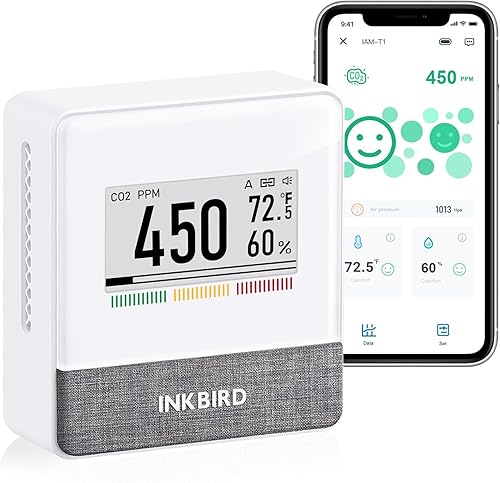
INKBIRD's monitor suits someone who wants readings on their phone without sending data to a cloud. Its Senseair NDIR sensor is rated to ±30 ppm +3%, and the Bluetooth 5.0 app shows CO2, temperature, humidity and air pressure in real time.
All usage data stays on your phone as local storage. Nothing is uploaded to a cloud server.
It runs up to 4 years on the included AA batteries when set to a 10-minute sampling interval. You can choose 1, 2, 5 or 10 minutes between readings, so a faster interval shortens battery life.
The e-ink screen stays readable from any angle. The monitor reads temperature from 32 to 122 °F.
The trade-off is the Bluetooth range. You need to be near the monitor to read the app, so it suits a room you sit in rather than a whole-house check.
A monitor with its own large display, like the SwitchBot below, is easier to glance at from across the room. The e-ink screen also updates slowly on longer sampling intervals, so the app is the better place to watch a trend.
SwitchBot CO2 Monitor: Best for a large, easy-to-read screen
- Swiss-made NDIR sensor
- 92mm screen with CO2, temperature, humidity and time
- Up to 12 months of battery
- Wall mount and bracket
A big-screen monitor with a broad CO2 range that you can hang on a wall or set on a bracket.
Pros
- 92mm screen readable from across a room
- Up to 12 months of battery
- Sound, screen and app alerts
Cons
- App alerts need a SwitchBot Hub
- Heavier and bigger than the pocket models
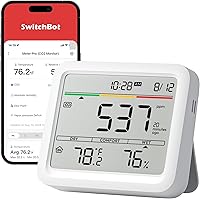
SwitchBot's monitor is the pick when you want a number you can read from the doorway. Its 92mm screen shows CO2, temperature, humidity, time and date together, and you can hang it on a wall or set it on an adjustable bracket at 42 or 90 degrees.
It measures CO2 from 400 to 9000 ppm with a Swiss-made NDIR sensor and refreshes every second. Its built-in battery lasts up to 12 months, so it can sit in a hallway or a home gym without a cable.
Sound, screen and app alerts can all be set to your own limits. The screen updates every second, faster than the e-ink models here, and it stores 38 days of readings locally.
It also shows the local outdoor temperature and humidity, which helps you plan when to air a room. App notifications need a SwitchBot Hub, so the phone alerts only work if you already use the SwitchBot system.
It is also heavier and bigger than the pocket-sized monitors, at 154 grams. For a big, readable display in one spot, it does the job well.
How we compared these portable CO2 monitors
We compared each monitor on four things a portable buyer cares about: sensor type, accuracy, battery life and how easy the screen is to read while carrying it. Every model here uses an NDIR sensor, which is the most reliable way to measure CO2 in a room.
If you want the technical background, our guide on what an NDIR sensor is explains why the sensor type matters more than the price.
Battery life split the group sharply. The Temtop C1 and Dienmern models charge over USB and run for days to weeks, while the Aranet4 and INKBIRD models use AA batteries and run for years.
The GoveeLife needs a wall outlet, so we scored it for fixed spots rather than true portability. The SwitchBot's 12-month figure sits in the middle.
Weight tracked the same split, with the pocket models under 5 ounces and the analyzers much heavier. Accuracy claims vary, from ±30 ppm +3% on the INKBIRD to ±50 ppm on the SwitchBot and Dienmern.
The Temtop C1 states its tolerance over the 400 to 2500 ppm band specifically. Those differences matter less than how each meter behaves in a real room, and our guide on what a good CO2 reading is gives you the bands to compare against.
| Product | Best for | Sensor | CO2 range | Power | Our score |
|---|---|---|---|---|---|
| Temtop CO2 Monitor Indoor air Quality Monitor | overall | NDIR | 400–5000 ppm | Battery, USB charging | 9.7 |
| Dienmern 5-in-1 CO2 Carbon Dioxide Detector | long trips away from an outlet | Swiss-made CO2 sensor | 400–5000 ppm | 1600mAh battery, USB charging | 9.6 |
| Aranet4 CO2 Monitor | multi-year battery life | NDIR | 2 AA batteries | 8.8 | |
| Temtop Professional Air Quality Analyzer & CO2 | logging data across a building | SenseAir NDIR | Rechargeable battery | 8.6 | |
| zemeollo Air Quality Monitor Indoor | checking a room's all-round air | CO2, HCHO, TVOC and particles | 2000mAh battery | 8.4 | |
| TEKCOPLUS CO2 Meter Portable CO2 Detector Digital | adjustable alarm limits | Non Dispersive Infrared | 0–9999 ppm | Battery powered | 8.2 |
| GoveeLife H5140 CO2 Monitor | smart home alerts | SCD4x photoacoustic NDIR | AC power | 8.0 | |
| INKBIRD Portable CO2 Detector with Bluetooth | phone-only readings | Senseair NDIR | 2 AA batteries | 7.9 | |
| SwitchBot CO2 Monitor | a large, easy-to-read screen | Swiss-made NDIR | 400–9000 ppm | Built-in battery | 7.0 |
What should you check before buying a portable CO2 monitor?
Start with the sensor. An NDIR sensor measures CO2 directly, while cheaper sensors estimate it from other readings.
Every monitor here uses NDIR, so the deciding factors become battery, display and alerts. The points below cover the questions buyers ask most often.
Which sensor type should you look for?
Look for NDIR. It shines infrared light through a sample of air and measures how much CO2 absorbs it, which gives a direct reading.
The Swiss-engineered and Senseair sensors in this group are NDIR designs with stated accuracy figures. A monitor that does not name its sensor type is harder to judge.
Watch for the stated range too, since some meters read to 5000 ppm and others to 9999 ppm. A wide range matters if you might use it in a greenhouse or a crowded hall, but for a living room the tighter band is enough.
How much battery life do you need?
It depends on how you move it. For carrying a monitor from room to room all day, USB charging with 20 to 72 hours per charge works well.
For a device that sits in a bag or on a shelf for weeks, AA batteries lasting years are the better fit. A plug-in model is fine if it stays in one spot.
Match the sampling interval to your patience, since a 1-minute refresh drains a battery faster than a 10-minute one. A sealed rechargeable battery also has a fixed life, while AA cells can be swapped.
Does screen size matter when you carry it?
Yes, in two ways. A big color screen is easy to read from across a room but drains the battery faster and adds weight, while a smaller e-ink screen sips power and stays readable from any angle but updates slowly.
Pick the screen that matches how often you look at it and how far away you stand. The SwitchBot's 92mm screen and the Aranet4's e-ink panel sit at opposite ends of that trade.
A screen you can read in dim light, like the TEKCOPLUS backlit LCD, helps in a bedroom or a basement.
Should you pick a monitor with app alerts?
Choose app alerts if the monitor will sit in a room you are not always in, like a nursery or a rental. The GoveeLife sends phone and email alerts, and the SwitchBot sends app alerts when paired with its Hub.
For a monitor you carry and watch yourself, the buzzer and screen colors are enough. Check whether the app needs a hub or extra hardware before you rely on phone alerts.
Also check what the app does with your data: the INKBIRD keeps it local, while the GoveeLife stores up to two years in the cloud.
How many readings do you need beyond CO2?
More readings help if you want a full picture of a room. The zemeollo shows ten metrics and the Temtop Professional shows eight.
For a portable CO2 monitor, though, CO2 plus temperature and humidity covers most day-to-day checks. Extra pollutants add cost and shorten battery life.
Note that none of these meters reads carbon monoxide, so a separate CO alarm is still needed for safety. If you are mainly worried about ventilation, CO2 alone tells you when to open a window.
Do portable CO2 monitors need calibration?
Most need little from you. NDIR monitors usually run automatic baseline calibration, which resets the sensor when it sees fresh outdoor air.
Open a window or step outside with the monitor now and then so it has a clean reference. Some models, like the GoveeLife, also offer manual calibration in the app, and the Temtop Professional has a built-in program for CO2 and HCHO.
A long stretch in a sealed room with no fresh air can leave the baseline drifting, so plan a regular airing. A monitor carried between rooms gets that fresh-air exposure naturally, while one left in a closed bedroom may need a manual reset more often.
How long will a portable CO2 monitor last?
Plan on several years. NDIR sensors in quality monitors are rated to last a long time, and the main wear items are the battery and the screen.
The Aranet4 and INKBIRD models run up to 4 years on AA batteries, while rechargeable models need a new charge every few days. Our guide on how long a CO2 monitor lasts covers sensor life and when to replace a unit.
A model with user-replaceable AA cells is easier to keep going than one with a sealed battery. The screen type also matters, since an e-ink panel draws almost no power and a bright color screen drains the cell faster.
Which portable CO2 monitor should you buy?
The Temtop CO2 Monitor Indoor air Quality Monitor is the best portable CO2 monitor for most people. Its Swiss-engineered NDIR sensor, 5-second refresh and 70-day standby battery make it easy to carry between rooms and check a space in seconds.
Pick it if you want one device for the office, the bedroom and the kitchen. Go with the Dienmern 5-in-1 if you need a bright screen and up to 72 hours per charge for trips, or choose the Aranet4 if you never want to think about charging.
For smart home alerts, the GoveeLife H5140 fits a fixed spot. If you are setting up monitors in several rooms at home, our roundup of the best CO2 monitors for home use covers the fixed and portable options together.
Our top 3 picks at a glance
-
1
-
2
Best for long trips away from an outlet
Dienmern 5-in-1 CO2 Carbon Dioxide Detector
9.6/10 our score
See it on Amazon -
3
Frequently asked questions
What should I look for in a portable CO2 monitor?
Look for an NDIR sensor first, since it is the most reliable way to measure CO2 in a room. Then match battery life and screen size to how you plan to carry it.
A portable monitor that moves between rooms should run on a battery and fit in one hand.
Can a portable CO2 monitor measure carbon monoxide too?
No, not unless the product says so. CO2 and CO are different gases measured by different sensors.
The Temtop C1, for example, cannot detect carbon monoxide.
For CO safety, buy a dedicated carbon monoxide alarm as well.
Why do two CO2 monitors in the same room show different numbers?
Sensor type, calibration and accuracy tolerances all affect the reading. A ±50 ppm difference between units is normal.
Compare trends and rough levels rather than expecting two meters to match to the digit.
Is a portable CO2 monitor worth it if I already have a smart thermostat?
Yes, if you want to know about CO2 specifically. Most thermostats track temperature and humidity but not CO2.
A portable monitor tells you when a closed room needs fresh air, which a thermostat cannot show.