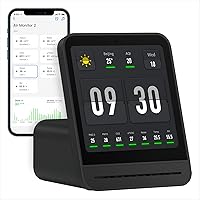
What Is a Good CO2 Reading on a Home Monitor?
A good CO2 reading in a home is generally around 1,000 ppm or lower. Higher readings can point to limited ventilation for the number of people in a room, but CO2 alone doesn't measure overall air quality or prove a health risk.
On this page (8 sections)
- What is a good CO2 reading for a home?
- What do common indoor CO2 readings mean?
- Why does CO2 rise in some rooms?
- How should you respond to a high CO2 reading?
- Where should you place a home CO2 monitor?
- Which CO2 monitor features help you read the number?
- Can you compare a CO2 reading with humidity or PM2.5?
- What is a good CO2 reading on a home monitor, in short?
A good CO2 reading in a home is generally around 1,000 ppm or lower, though that number is a ventilation guide, not a strict safety line. If the reading climbs as people spend time in a room, ventilation may be limited for the room's size and occupancy.
CO2 monitors measure carbon dioxide in parts per million (ppm). They can help you spot patterns, but they don't measure every pollutant or tell you whether all aspects of indoor air are good.
What is a good CO2 reading for a home?
Around 1,000 ppm or lower is a practical reference for a home CO2 reading. The actual number depends on how many people are in the room, its size, and how quickly outdoor air replaces indoor air.
Treat the reading as a prompt to notice conditions, not a pass-or-fail test. A brief rise while people are gathered in a small room can differ from a persistent high reading in a room with few occupants.
CO2 is a gas people exhale, so indoor levels often rise with occupancy. A monitor reading doesn't identify the cause by itself, and CO2 isn't a complete measure of indoor air quality.
For context on other readings, see our guide to how to read numbers on an air quality monitor. It explains why each measurement needs its own interpretation.
What do common indoor CO2 readings mean?
Use ranges to understand ventilation patterns, not to label a room safe or unsafe. A reading that rises during room use and falls after airing out can help you understand how air moves through the space.
- Near outdoor background: Indoor and outdoor air may be mixing well, but conditions vary.
- Around 1,000 ppm: A useful point to check whether the room needs more fresh air.
- Above 1,000 ppm: Consider whether occupancy, room size, and ventilation explain the rise.
- A sustained rise: Check placement and room conditions, then try ventilation if appropriate.
The figures are not medical thresholds. They don't account for every person's needs, nor do they show pollutants such as particles or radon.
Is 2,000 ppm CO2 too high?
A sustained reading around 2,000 ppm suggests limited air exchange for the room's current use. It can be a reason to improve ventilation, but one number alone doesn't guarantee a health risk.
Check that the monitor is placed away from faces, windows, vents, and direct sunlight. Give it time to respond, then compare the reading before and after a ventilation change.
For an overview of what CO2 monitors can tell you, read CO2 monitors for home use. That guide covers the role and limits of these devices.
Why does CO2 rise in some rooms?
CO2 rises when people add it to indoor air faster than ventilation removes it. Smaller rooms, closed doors, and groups of people can make the increase more noticeable.
A bedroom with the door and windows closed may show a higher reading after several hours of occupancy. A kitchen or living room can also show changes when several people gather there.
Room size and air exchange matter as much as the monitor's location. If you're comparing rooms, note how many people are present and whether doors, windows, or ventilation systems are operating.
The reading can change after you open a window or turn on a ventilation fan. Outdoor conditions and the direction of airflow also affect how quickly the indoor number moves.
How should you respond to a high CO2 reading?
First check the monitor and room conditions, then ventilate if it makes sense. A single high reading is a reason to look for context, not to panic.
- Check that the monitor is in the occupied part of the room, not right beside a person's face.
- Give the monitor time to settle after moving it or changing room conditions.
- Consider how many people are present and whether doors or windows are closed.
- If outdoor air is suitable, open a window or use an exhaust fan to improve air exchange.
- Watch whether the reading falls and whether the pattern repeats.
Standard air purifiers don't lower CO2. If a room needs ongoing fresh air, consider ventilation options suited to the space rather than relying on particle filtration.
To understand how sensor design affects the reading, see what an NDIR sensor is in a CO2 monitor. Sensor type is one factor to consider when comparing monitors.
Where should you place a home CO2 monitor?
Place the monitor where people spend time, with space around it for room air to circulate. Keep it away from a person's direct breath, open windows, supply vents, and spots with direct sunlight.
Use the same location when you compare readings across days. Moving the monitor between rooms can be useful, but note that each room has different occupancy and airflow.
Don't place it directly beside a window and treat that result as the room's typical reading. A spot next to an air vent can also show a different pattern from the middle of the room.
Which CO2 monitor features help you read the number?
A clear display and useful history can make it easier to connect CO2 changes with room use. Choose features based on whether you want a glanceable reading, alerts, or a record over time.
The Aranet4 CO2 Monitor measures CO2, temperature, relative humidity, and atmospheric pressure, with an e-ink display, optional buzzer, and app history for up to 90 days.
The GoveeLife H5140 CO2 Monitor shows CO2, temperature, humidity, and a clock, with customizable alerts and app history of up to 2 years.
The Temtop M10+ CO2 Meter also measures PM2.5, TVOCs, temperature, and humidity, and supports app access and hourly data logging.
The Temtop CO2 Monitor measures CO2, temperature, and humidity, with a buzzer and a 3-color indicator.
A CO2 monitor doesn't replace a smoke alarm or carbon monoxide alarm. Choose a separate certified alarm for those hazards.
Can you compare a CO2 reading with humidity or PM2.5?
CO2, humidity, and PM2.5 describe different things, so interpret each on its own. A normal result for one reading doesn't confirm that the others are also in range.
CO2 can help you notice changes in ventilation. Humidity describes moisture in the air, while PM2.5 measures tiny airborne particles.
For the moisture reading, see what a good indoor humidity level is. For particles, read what PM2.5 means on an air quality monitor.
What is a good CO2 reading on a home monitor, in short?
For a home CO2 monitor, use around 1,000 ppm or lower as a practical ventilation reference, then pay attention to patterns during normal room use. If readings climb and stay raised, check the placement and consider ways to bring in fresh air.
Choose a monitor with the display, alerts, and history that match how you'll use it. If you also want to understand sensor technology, start with NDIR sensors in CO2 monitors.
Frequently asked questions
What is a good CO2 reading in a house?
A home reading around 1,000 ppm or lower is a common ventilation reference, though it isn't a strict safety boundary. The number changes with occupancy, room size, and air exchange.
Look at the pattern over time and compare similar conditions instead of treating one reading as a verdict on the whole home.
Is 1,500 ppm CO2 high indoors?
A reading of 1,500 ppm is above the often-used 1,000 ppm ventilation reference and may mean the room needs more fresh air for its current occupancy. It doesn't, by itself, show that the room is dangerous.
Check placement, allow the reading to settle, and see whether ventilation brings the number down.
What CO2 level is too high in a bedroom?
There isn't one bedroom number that applies to every home, because room size, occupancy, and ventilation differ. A reading that rises while the room is occupied can be a useful cue to air it out.
Check the trend over several nights, and consult a qualified professional if you have a specific health concern.
Do air purifiers lower CO2?
A standard air purifier doesn't remove carbon dioxide from room air. To lower a raised indoor CO2 reading, bring in outdoor air through ventilation, such as opening windows when conditions allow or using an appropriate fresh-air system.
Exhaust fans can also help move indoor air out.