8 Best Air Quality Monitors for Bedrooms (November 2026)
The best bedroom air quality monitors include the GoveeLife Smart Air Quality Monitor with PM2.5 (best overall for most bedrooms), the DREO Air Purifier for Home for purifying and monitoring in one unit, and the Heouakc 10-in-1 Air Quality Monitor Indoor for the widest range of readings.
On this page (4 sections)
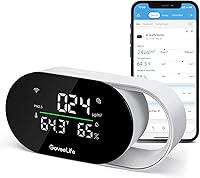
The best air quality monitor for bedroom use is the GoveeLife Smart Air Quality Monitor with PM2.5 (H5106). It tracks the particles a bedroom purifier targets, dims its screen for sleep and stores long-term data in an app.
If your main worry is stuffy air, the Aranet4 CO2 Monitor is the better fit.
A bedroom is a closed box for eight hours a night. That makes it the room where air readings matter most, and also the room where a bright screen or a loud alarm can ruin your sleep.
The monitors here differ mostly in what they measure and how quietly they do it.
Some track particles. Some track carbon dioxide.
A few do both. Start by deciding which question you want answered.
If you want the wider picture of how monitors sense the air, our guide on how air quality monitors work explains the sensor types behind each reading.
Our picks at a glance
-
1
 Best overall for most bedrooms
GoveeLife Smart Air Quality Monitor with PM2.5
9.7/10 our score
See it on Amazon -
2

-
3
 Best for the widest range of readings
Heouakc 10-in-1 Air Quality Monitor Indoor
9.4/10 our score
See it on Amazon
- 4
 Best for overnight CO2 trackingCheck it
- 5
 Check it
Amazon Smart Air Quality Monitor
Best for Alexa households - 6
 Check it
VENDFO Air Purifiers for Home Bedroom Up
Best for quiet all-night purification - 7
 Best for CO2 with smart alertsCheck it
- 8
 Check it
Temtop LKC-1000S+ Air Quality Monitor
Best for tracking particle trends
The best air quality monitors for bedrooms
GoveeLife takes the top spot for balanced coverage and night-friendly operation. The rest of the list fills in where a single monitor type falls short, from CO2 tracking to a purifier that reads the air as it cleans.
GoveeLife Smart Air Quality Monitor with PM2.5: Best overall for most bedrooms
- PM2.5, temperature and humidity
- 2-second refresh
- Night mode and 4-level LED
- 2.4G Wi-Fi and app control
A three-sensor bedroom monitor with a dimmable display and app alerts. It costs less than a CO2-focused meter while covering the particles most bedroom air purifiers target.
Pros
- PM2.5 accuracy of plus or minus 15 ug/m3
- Night mode dims the screen
- Two years of exportable data
Cons
- Needs a power outlet
- No CO2 sensor
GoveeLife's H5106 is the easiest monitor to live with beside a bed. It measures PM2.5, temperature and humidity, the three readings that most directly describe a bedroom's comfort.
The PM2.5 sensor is rated at plus or minus 15 ug/m3 and corrects its data every two seconds.
Night mode matters more than the spec sheet suggests. A long press on the top button switches to a dim screen, so the display won't glow across the room at 2 a.m.
The four-level LED shows air quality at a glance when you'd rather not read numbers.
The app is where this monitor earns its place. You can set a target air quality and link GoveeLife purifiers, humidifiers or heaters so they respond automatically.
Online graphs cover 13 days and exports go back two years. Note that the unit only uses Type-C cables and has no built-in battery.
Two limits stand out. The H5106 needs a power source and a 2.4G Wi-Fi network, so plan an outlet near the nightstand.
It also has no CO2 sensor, which is why the next picks exist. If you want an app-driven monitor in a different shape, our roundup of the best smart air quality monitor options covers more of them.
DREO Air Purifier for Home: Best for purifying and monitoring in one unit
- Built-in PM2.5 sensor
- AQI display from 1 to 999
- Sleep mode turns off lights
- AHAM Verified at 115 CFM
A bedroom air purifier with a real-time PM2.5 readout, so the same unit cleans the air and shows you how it's doing. The trade-off is that it only reports particles.
Pros
- PM2.5 sensor and 4-color AQI light
- Sleep mode goes dark and quiet
- AHAM Verified 115 CFM
Cons
- No CO2, VOC or temperature readings
- Fan runs constantly to keep air clean
The DREO 338 suits someone who would rather buy one device than two. It's an AHAM Verified air purifier with a 115 CFM clean air delivery rate, and it refreshes a 178 sq ft room every 12.4 minutes.
That's a typical primary bedroom.
Its built-in PM2.5 sensor drives both a numeric AQI display from 1 to 999 and a four-color light that runs blue to red. Auto mode uses the same sensor to speed the fan up when particles rise and slow it down when they fall.
In practice, the readout tells you whether the purifier is winning.
Sleep mode turns off the display lights and quiets the motor, so the unit can run all night without lighting the room. The 3-in-1 filter combines a pre-filter, a high-efficiency layer and activated carbon for particles and odors.
Energy Star certification puts consumption around 125 kWh a year, which keeps the all-night habit cheap. There's also a scent diffuser pad, though essential oils aren't included.
The trade-off is scope. This unit reads particles and nothing else: no CO2, no VOCs, no humidity.
Choose it when clean air and a quick particle check are the goal. Go with a dedicated monitor if you want to understand gases or ventilation.
Our home monitor roundup covers units built for whole-house checks.
Heouakc 10-in-1 Air Quality Monitor Indoor: Best for the widest range of readings
- PM0.3, PM2.5, PM10, CO2, CO, HCHO, TVOC, AQI
- Color-coded levels
- 1.2-second sampling
- 2,000 mAh battery, up to 96 hours
The most sensors in this group, with a rechargeable battery so you can carry it between rooms. The color scale makes bedroom readings easy to read at a glance.
Pros
- CO2, CO, HCHO and TVOC coverage
- Rechargeable with 96-hour battery
- Audible alert you can mute
Cons
- No app or smart-home link
- Screen is brighter than a night-mode display
The Heouakc 10-in-1 covers more ground than any monitor here. It reads PM0.3, PM2.5, PM10, CO2, CO, HCHO, TVOC, AQI, temperature and humidity, sampling every 1.2 seconds.
If you want one device to tell you everything about a bedroom, this is it.
The display turns those numbers into a color scale from Good to Serious. You can glance at it from bed and know whether to open a window.
A real-time audible alarm sounds when air quality hits a level you set, and one button mutes it.
Portability is the other strength. A 2,000 mAh battery runs up to 96 hours on a charge, so you can move the monitor between bedrooms, a nursery or a home office without hunting for an outlet.
There's no Wi-Fi, Bluetooth or app setup at all.
The trade-offs are real. A color screen is brighter than the dimmable displays on the GoveeLife and Aranet4, so place it across the room rather than on the nightstand.
And there's no app, so no remote readings or history. For a bedroom where you just want the facts in front of you, neither matters much.
Its CO reading is a useful extra if a gas appliance sits nearby.
Aranet4 CO2 Monitor: Best for overnight CO2 tracking
- NDIR CO2 sensor
- E-ink display
- Up to 4-year battery life
- 90-day app history
The reference CO2 meter for a closed bedroom. Its e-ink screen stays readable in the dark without lighting the room, and the batteries last years.
Pros
- NDIR CO2 sensor with a 4-year battery
- E-ink display doesn't glow
- 90 days of history in the app
Cons
- No particle sensor
- Premium price for a CO2-only meter
The Aranet4 is the monitor to buy when the question is "is my bedroom stuffy?" It measures CO2, temperature, relative humidity and atmospheric pressure with an NDIR sensor, the most precise method for carbon dioxide.
It's the top-rated CO2 monitor in its Amazon segment.
Its e-ink display is the reason it belongs on this list. It shows a large CO2 number with color coding and doesn't glow like a backlit screen.
That makes it the least disruptive monitor to keep at eye level all night. An optional buzzer warns when CO2 runs too high.
Power is the other standout. Two AA batteries run it for up to 4 years, so there's no cable across the floor and no outlet to plan around.
The free app stores 90 days of history with simple graphs, enough to spot a room that never gets fresh air.
The trade-off is that this is a CO2 specialist. It won't tell you about dust, smoke or VOCs.
Pair it with a particle-reading monitor or a purifier when particles matter, or choose it alone if ventilation is your only concern. The price sits well above the basic monitors here for that focus.
It's made in the EU and sold in more than 130 countries.
Amazon Smart Air Quality Monitor: Best for Alexa households
- PM2.5, VOCs, CO, humidity and temperature
- Color-coded LED and air quality score
- Alexa app alerts and Echo announcements
- Routines with other Alexa devices
A five-sensor monitor that talks to Alexa, so a drop in air quality can trigger an announcement or start a purifier. Best if your bedroom already runs on Echo devices.
Pros
- Five sensors including carbon monoxide
- Echo announcements when air quality drops
- Routines can switch on a purifier or fan
Cons
- Alexa app only, no standalone display readings
- Needs a power outlet
Amazon's monitor fits a bedroom that already runs on Alexa. It tracks PM2.5, VOCs, carbon monoxide, humidity and temperature, five readings that cover particles, gases and comfort in one small plug-in unit.
The color-coded LED gives a rough sense of current air quality. The Alexa app adds a numeric score and the detail behind it.
You can set routines so a drop in air quality turns on a compatible purifier, fan or dehumidifier without you lifting a finger.
Alerts are the feature that earns it a bedroom badge. A phone notification or an announcement on an Echo device tells you when air quality falls, so you don't need to watch a display.
That's useful in a nursery or a room where the monitor sits out of sight. Setup is just plugging it in and opening the app.
The catch is the app dependency. There's no standalone numeric display to read at night, and no CO2 sensor.
If you don't use Alexa, the GoveeLife H5106 offers a similar sensor set with a screen of its own. If you do, this is the least intrusive way to add air data to your smart home.
It can also feed a Smart Thermostat for room-by-room comfort.
VENDFO Air Purifiers for Home Bedroom Up: Best for quiet all-night purification
- Built-in particle sensor with 3-color light
- 25 dB sleep mode
- H13 HEPA filter
- 2, 6 or 12-hour timer
The quietest way to keep a bedroom clean while watching for particle spikes. A built-in sensor drives the auto fan speed and a simple blue, orange or red light.
Pros
- 25 dB sleep mode
- Auto fan speed follows particle levels
- Timer for 2, 6 or 12 hours
Cons
- No numeric PM2.5 readout
- No CO2 or gas readings
The VENDFO purifier targets the bedroom problem directly: keep the air clean while everyone sleeps. Its sleep mode runs at 25 dB, quieter than a whisper, and the display goes dark so nothing glows.
It covers up to 1,250 sq ft, with 4 air changes per hour in a 312 sq ft room. A 3-stage H13 HEPA filter handles smoke, PM2.5, pollen and pet hair.
A dedicated fragrance pad lets you add essential oils without putting them through the filter.
The monitoring side is simple by design. A built-in particle sensor tracks air quality and drives a blue, orange or red indicator, and auto mode ramps the fan up when pollution rises.
A timer shuts it off after 2, 6 or 12 hours. The filter reminder flashes on the timer button after roughly 1,440 hours, or about four months at 12 hours a day.
That's less information than a dedicated monitor gives. There's no numeric PM2.5 readout and no CO2 or gas tracking.
Choose it when you want a quiet purifier that reacts to the air, not a meter to study. Pick the GoveeLife or Heouakc if the numbers are the point.
The unit is small at under 3 pounds, so it tucks into a corner.
GoveeLife H5140 CO2 Monitor: Best for CO2 with smart alerts
- Photoacoustic NDIR CO2 sensor
- 5-second refresh
- Triple alert system
- 2-year data export and smart links
A CO2 meter built for bedroom and nursery use, with alerts that reach your phone and a display that dims on a schedule. The app adds two years of exportable history.
Pros
- CO2 accuracy of plus or minus 40 ppm plus 5%
- Alerts by buzzer, app and email
- Screen brightness follows a day and night schedule
Cons
- Needs an outlet, no battery
- Air purifiers can't lower the CO2 it measures
GoveeLife's H5140 is a CO2 meter with smart-home manners. It uses a photoacoustic NDIR sensor rated at plus or minus 40 ppm plus 5%, refreshing every 5 seconds.
That's precise enough to show a bedroom's overnight build-up of exhaled CO2. Built-in pressure compensation keeps readings steady at altitude.
The triple alert system is what sets it apart. When CO2, temperature or humidity crosses a level you set, you get a buzzer, a phone notification and an email report.
That matters in a nursery or for anyone caring for an older relative.
The 4.82-inch display shows CO2, temperature, humidity and a clock. A tri-color light bar follows a day and night schedule you set in the app, so the screen stays bright when you need it and dark when you don't.
Two years of history can be exported as a CSV. It works with Alexa and Google Assistant for voice checks.
One honest limit: it needs an AC outlet and has no battery. GoveeLife also notes that air purifiers can't lower CO2, so this meter pairs with ventilation, not a filter.
Choose it when CO2 and smart alerts matter more than particles.
Temtop LKC-1000S+ Air Quality Monitor: Best for tracking particle trends
- PM2.5, PM10, HCHO, VOCs, temperature, humidity, AQI
- 12-hour trend histogram
- USB data export to Excel
- 6 to 8-hour battery
A semi-professional meter that shows how particles move through the night on a 12-hour histogram. Useful for checking whether a purifier or a cracked window is working.
Pros
- 12-hour trend histogram
- Excel export with no app or subscription
- Dart electrochemical HCHO sensor
Cons
- Needs warm-up time after moving between rooms
- Doesn't detect gas or CO leaks
Temtop's LKC-1000S+ is for the reader who wants to see a night's trend, not a single reading. It tracks PM2.5, PM10, HCHO, VOCs, temperature, humidity and AQI and draws a 12-hour histogram so peaks from cooking, candles or a closed window stand out.
The Dart electrochemical HCHO sensor is a step above the cheap semiconductor types in basic meters. Data can be exported to Excel over USB with no app or subscription, which suits anyone tracking a renovation or a health concern over months.
The laser particle sensor has a designed lifespan of three years.
It runs plugged in for continuous monitoring or on its 6 to 8-hour battery for spot checks. The color display shows green, yellow or red without digging through menus.
Allow 10 minutes of warm-up after moving it between hot and cold rooms, and keep strong cleaners and perfumes away from it during a test.
That warm-up is the main drawback for bedroom use. It also doesn't detect gas or CO leaks.
Choose it when particle trends and formaldehyde readings matter. For simple overnight CO2 checks, the Aranet4 does the job with less fuss.
Our explainer on how accurate home air quality monitors are helps you read its numbers in context.
How these bedroom monitors compare
The comparison table puts the readings, power source and smart features side by side. Look at the first column first, since the sensor set decides what a monitor can tell you.
Power comes next, because a bedroom has few free outlets and a cable across the floor is a trip hazard at night. Night behavior rounds out the picture.
| Product | Best for | Measures | Power | Data storage | Our score |
|---|---|---|---|---|---|
| GoveeLife Smart Air Quality Monitor with PM2.5 | overall for most bedrooms | PM2.5, temperature, humidity | USB-C, wired | 13-day online graphs, 2-year export | 9.7 |
| DREO Air Purifier for Home | purifying and monitoring in one unit | PM2.5 and AQI | 9.5 | ||
| Heouakc 10-in-1 Air Quality Monitor Indoor | the widest range of readings | 10 parameters including CO2 and CO | USB-C rechargeable, 96-hour battery | 9.4 | |
| Aranet4 CO2 Monitor | overnight CO2 tracking | CO2, temperature, humidity, pressure | 2 AA batteries, up to 4 years | 8.8 | |
| Amazon Smart Air Quality Monitor | Alexa households | PM2.5, VOCs, CO, humidity, temperature | Plug-in | 8.4 | |
| VENDFO Air Purifiers for Home Bedroom Up | quiet all-night purification | Particles via built-in sensor | 8.3 | ||
| GoveeLife H5140 CO2 Monitor | CO2 with smart alerts | CO2, temperature, humidity, clock | AC plug, 24/7 monitoring | 8.0 | |
| Temtop LKC-1000S+ Air Quality Monitor | tracking particle trends | 7 parameters including HCHO and VOCs | USB-C or 6 to 8-hour battery | 7.3 |
How we compared these monitors
We weighed each monitor's sensor set against what a bedroom reader actually needs. A CO2 sensor matters for stuffy rooms.
A particle sensor matters when a purifier runs overnight. Both matter when you want the full picture.
Our score also counts how a monitor behaves after dark. Night mode, display dimming, silent alerts and battery power all raised a unit's score.
So did app features like history graphs and smart-home links. A monitor that lights the room or needs a cable strung across the floor lost points.
We checked specs against each brand's own published accuracy figures and features. We did not run bench tests or sleep beside these units.
The scores reflect published specs and how each monitor fits the job of reading bedroom air.
What to look for in a bedroom air quality monitor
Start with the sensor type, then work down to power and night behavior. Most bedroom buyers regret buying a bright, app-only monitor more than they regret a smaller sensor set.
Which sensor should a bedroom monitor have?
Pick a particle sensor when dust, smoke or pollen is your concern. PM2.5 is the standard reading, and it's what most purifiers target.
Pick a CO2 sensor when stuffiness or poor ventilation is the problem. CO2 climbs in a closed room overnight and only fresh air brings it down.
If you can only choose one, think about the room. A well-sealed bedroom next to a busy road may need particle data more.
A small bedroom with the door shut all night usually needs CO2 data. A multi-parameter monitor like the Heouakc covers both, at the cost of a busier display.
What makes a monitor good for sleeping?
The best bedroom monitors can go dark and quiet. Look for a night mode or scheduled dimming, like the GoveeLife H5106 and H5140 offer.
An e-ink screen like the Aranet4's doesn't glow at all.
Check the alert style too. An audible buzzer is useful in a nursery but annoying beside your pillow unless it can be muted.
App and email alerts let you keep the monitor silent while still getting warned. And a battery-powered unit means no cable trailing across the floor.
The Aranet4 runs up to four years on AA cells, while the Heouakc gives you 96 hours per charge.
Do you need an app or smart-home link in a bedroom?
You need one only if you want remote readings, history or automation. An app lets you check the air from another room and export trends.
Smart links let a monitor trigger a purifier or fan when air quality drops, which the GoveeLife H5106 and Amazon monitor both do. The H5106 connects to GoveeLife purifiers and heaters, and the H5140 to GoveeLife humidifiers and tower fans.
A standalone monitor like the Heouakc 10-in-1 skips all of that. It shows everything on its own screen with no setup.
That's simpler and more private, but you give up history and remote alerts. Choose based on whether you'd rather glance at a display or open a phone.
Monitor or purifier: which comes first for a bedroom?
A purifier comes first if particles are your concern. It removes dust, smoke and pollen and most units include a basic sensor.
The DREO and VENDFO picks here both purify and give you an air-quality indicator. The DREO even shows a numeric AQI.
A monitor comes first when you want to understand the air before buying anything. It tells you whether the problem is particles, CO2 or gases.
A monitor also helps you check whether a purifier is actually working. Many bedrooms end up with both, with the monitor confirming what the purifier does.
How much does placement affect a bedroom reading?
More than most people expect. A monitor set against a wall or next to a curtain reads a pocket of still air, not the room.
Leave a little space around the sensor and keep it clear of hair and debris, since a blocked intake gives false readings. GoveeLife's own guidance says to clear the sensor and restart the device if numbers look wrong.
Height matters too. A nightstand puts the monitor near your breathing zone, which is the air that matters most overnight.
Avoid sitting it right beside a purifier's vent, where the outflow skews the numbers. If a reading looks strange after you move the unit, give it time to adjust, as Temtop recommends a 10-minute warm-up after a change in temperature.
Which bedroom air quality monitor should you buy?
The GoveeLife Smart Air Quality Monitor with PM2.5 (H5106) is the best air quality monitor for bedroom use for most people. It reads particles, temperature and humidity, dims for sleep and stores long-term data in an app.
The price is modest for what it covers.
The rest of the list is a set of clear alternatives. Pick the Aranet4 CO2 Monitor for overnight ventilation checks and a screen that never glows.
Pick the Heouakc 10-in-1 for the widest sensor range and battery portability. Pick the GoveeLife H5140 when you want CO2 alerts pushed to your phone.
If you'd rather purify than measure, the DREO 338 covers a typical bedroom with an AHAM Verified 115 CFM and a sleep mode. The VENDFO is the quietest option at 25 dB.
For a smart-home setup, the Amazon monitor slots into Alexa routines without extra hardware.
Still unsure? Read our wider air quality monitor buyer's guide for the home to compare bedroom-focused units with models built for larger rooms.
A monitor that suits your sensors and your sleep habits is the one you'll keep plugged in.
Our top 3 picks at a glance
-
1
Best overall for most bedrooms
GoveeLife Smart Air Quality Monitor with PM2.5
9.7/10 our score
See it on Amazon -
2
-
3
Best for the widest range of readings
Heouakc 10-in-1 Air Quality Monitor Indoor
9.4/10 our score
See it on Amazon
Frequently asked questions
Where should I put an air quality monitor in a bedroom?
Place it on a nightstand or shelf at about breathing height, away from walls and air purifier vents. Sensors read best with a little open air around them, and that spot also shows what you breathe while sleeping.
Do bedroom air quality monitors need Wi-Fi?
Only if you want remote readings or smart-home links. The Heouakc 10-in-1 runs entirely on its own with no Wi-Fi or app.
GoveeLife and Amazon monitors need 2.4G Wi-Fi for their apps and alerts.
Can an air purifier lower bedroom CO2?
No. Standard air purifiers filter particles and gases but do not remove carbon dioxide.
The GoveeLife H5140 confirms this in its own guidance.
To lower CO2 in a bedroom, open a window or door to bring in fresh air.
Why does my bedroom CO2 read high in the morning?
A closed bedroom traps the CO2 you exhale overnight. Levels climb until you open a window or door.
A CO2 monitor helps you see when it's time to ventilate, and many people crack a window before sleeping.
Do these monitors make noise at night?
The monitors here are silent. The air purifiers in this list have sleep modes: DREO turns its lights off and runs quiet, and VENDFO rates its sleep mode at 25 dB.
The Heouakc can sound an audible alarm, which you can mute.
Is a particle sensor or a CO2 sensor better for a bedroom?
Both answer different questions. A particle sensor shows dust, smoke and pollen levels and pairs well with a purifier.
A CO2 sensor shows whether fresh air is reaching the room.
Many bedrooms benefit from tracking both.